 Tompkins Robotics
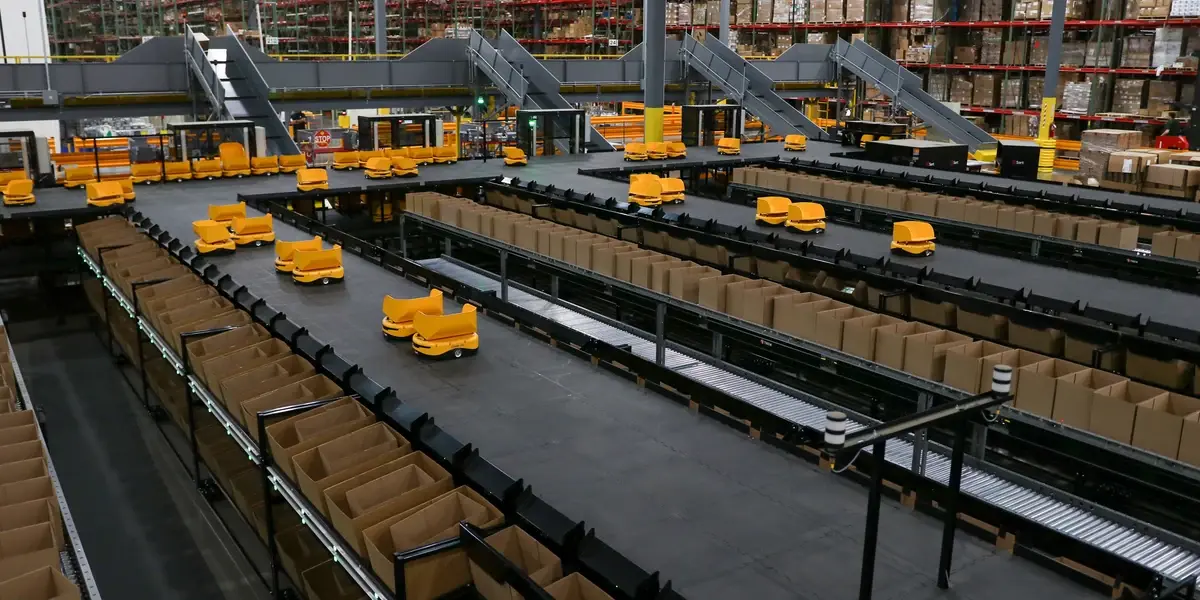
Before you compare sorter models, there's a bigger decision hiding underneath: fixed or flexible architecture. Fixed sortation (every loop, line, and conveyor divert) sets your throughput, destinations, and layout in steel on install day. tSort defines them in software and delivers them with a robot fleet. This page compares the two architectures on the only test that matters over a 15-year horizon: what happens when something changes.
tSort: Flexible Architecture
Modular platform, robot fleet, software-defined destinations. Change is an update, not a project.
Fixed Infrastructure
Loops, lines, and conveyors bolted to the floor. Capacity and layout are set at install.
Every sorter comparison in this series reduces to this one architectural split.
The bet every fixed sorter makes
A fixed sorter is engineered around a snapshot: today's volume, today's item mix, today's destination count, today's building. That's the design, not a flaw in it. Fixed infrastructure achieves its throughput by committing steel to a specific operating profile.
The problem is the snapshot expires. Over the 10-to-20-year life of a sortation system, the average operation will change its SKU profile, its parcel mix, its network design, its peak-to-baseline ratio, and often the building itself. A fixed system prices each of those changes as an engineering and construction project. Many operations end up running their network around the sorter's limitations instead of the other way around.
How tSort changes the architecture
tSort is a fleet of autonomous mobile robots sorting across an elevated, modular platform. Throughput comes from fleet size. Destinations are software assignments. The platform assembles without structural modification and disassembles the same way.
The performance holds up on its own (50,000+ items per hour, 6,000+ destinations, items from 1 oz to 65 lbs, up to 75% less floor space), but the architectural point is what those numbers cost to change: almost nothing.
What happens when something changes
This is the comparison that matters. Same events, two architectures:
| When this happens | Fixed Infrastructure | tSort |
|---|---|---|
| You need more destinations | Extend the loop or line: engineering, fabrication, months of construction | Assign new destinations in software; add chutes on the platform |
| Peak season doubles volume | System runs at its fixed ceiling; overflow goes to manual labor | Add robots for peak, scale the fleet back after |
| Your item mix shifts | Items outside the design spec jam, damage, or divert to manual | 1 oz to 65 lbs, square, round, bagged, or loose on one system |
| You move or expand facilities | The sorter stays behind; you buy another one | The platform disassembles and relocates |
| A component fails mid-shift | One track or drive fault can stop the entire sort | The fleet absorbs it, since no single robot can stop the sort |
| Volume grows 30% over 3 years | Hope the original design left headroom; otherwise, retrofit | Add robots as growth arrives; pay as you scale |
| The business case is reviewed | Capital committed up front for peak capacity, used fully 2 months a year | Modular investment tracks actual volume |
When fixed infrastructure might still be the better fit
Fixed sorters earn their keep in one scenario: extremely high, extremely stable volume in a facility that will not change. A national parcel hub running 60,000+ units per hour around the clock, year-round, in a purpose-built building can fully utilize a large cross belt loop, and at that utilization, its per-unit economics are strong. If your operation genuinely matches that profile and you're confident it will for 15 years, fixed infrastructure is a rational choice.
The category-level and technology-level comparisons in this series give each fixed system its honest due: loop sorters, linear sorters, and the individual matchups under each.
When tSort is the better choice
For everyone whose next 15 years won't match a snapshot. If your volumes swing seasonally, your item mix is diversifying, your destination count grows, your network design gets revisited, or your building lease has an end date, the flexibility premium isn't really a premium. It's the cheaper path, because you stop paying construction prices for operational change.
That's the claim behind the whole series: nothing in the market compares to tSort's flexibility, and with tSort you don't trade throughput to get it.
Stop designing around your sorter.
See a system that adapts to your operation instead, live, with your item profile and destination map.
Talk to a tSort Specialist Schedule a Virtual Lab TourFrequently asked questions
Isn't "flexible" just a way of saying "slower"?
No. That's the assumption this comparison exists to correct. tSort sorts 50,000+ items per hour to 6,000+ destinations, matching or beating most fixed installations. Flexibility here isn't a trade against throughput; it's the removal of the constraints fixed systems accept to get theirs.
What does a fixed sorter really cost over its life?
Day-one capital ($3M to $8M+ for loops) is only the visible part. The rest shows up later: construction pricing on every destination change, capacity ceilings during peak, manual labor for off-spec items, and a full re-buy if the facility changes. Total cost of ownership comparisons that include change events consistently favor modular systems.
How disruptive is switching from fixed sortation to tSort?
Less than replacing one fixed system with another. tSort's platform installs in 5 to 7 months without structural modification, and can run in parallel with an existing sorter during transition, with volume shifting over as the legacy system winds down.
Where should I start if I'm early in evaluating sortation?
Start with the 10-sorter comparison guide to learn the categories, then the matchup pages for any technology on your shortlist. When you're ready to see the difference rather than read about it, book the lab tour.
Go deeper in the series
Category guides: vs. Loop Sorters · vs. Linear Sorters · vs. Put Walls
Start at the top: tSort: the world's most flexible sorter · All 10 sortation types compared