 Tompkins Robotics

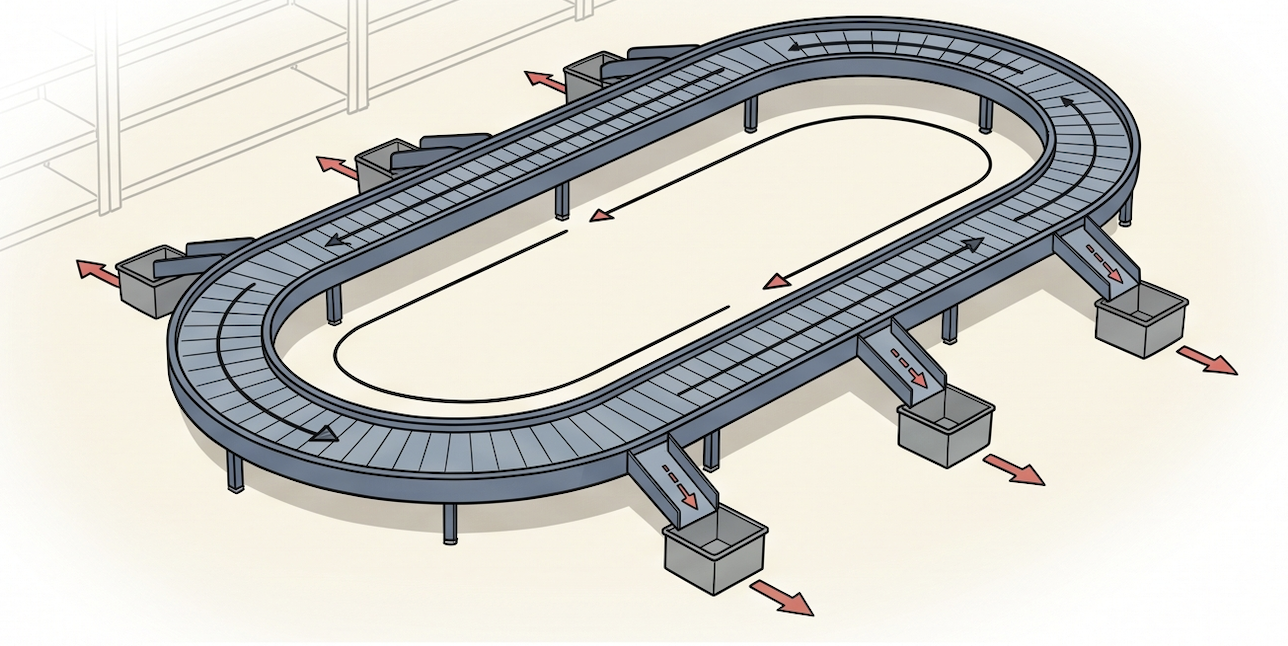
Loop sorters (tilt tray, cross belt, bombay, and pouch systems) deliver high throughput by running items around a fixed track with limited sort destinations. tSort delivers the same class of throughput with a fleet of autonomous mobile robots instead, and no fixed track at all. The short version: loop sorters win when nothing about your operation will change for 15 years. tSort wins when something will.
tSort · AMR Sortation
Fleet of autonomous robots, multi-level design, high sort desination density, no fixed infrastructure, intelligent software, omnichannel fulfillment.
Loop Sorters
Carriers circulate a fixed, continuous track. Every destination is a physical position on the loop.
The architectural difference behind every score below: software-defined destinations vs. steel-defined destinations.
What counts as a loop sorter?
Loop sorters are a type of fixed infrastructure sorter that carry individual items on a continuous track and discharge them at fixed points. The discharge mechanism varies between the different types, which is the main difference within the group.
- Tilt tray: trays tilt and gravity slides the item into a chute. Wide product mix, gentle handling, throughput up to ~43,000 units/hour for small tray sizes.
- Cross belt: each carrier has its own small belt that actively moves the item off. Widest product range of the loop family and the highest throughput, at the highest price.
- Bombay: trap doors in the carrier floor drop items through. Fast and mechanically simple, but only for small, flat, durable items.
- Pouch: fabric pouches hang from an overhead rail. Gentle handling for apparel and returns, moderate throughput, long installs.
They share the strengths: sustained high throughput and decades of proven deployments. They also share the constraints: elevated steel structure, conveyor induction networks, 12 to 24 month implementations, and capital costs that typically run $3 million to $8 million or more. For a deeper look at each type, read the full warehouse sortation systems guide.
How tSort works
tSort replaces the track with a fleet of autonomous mobile robots operating on a multi-level modular platform. Each robot picks up an item at an induction station, routes itself to the assigned destination by the shortest available path, and discharges by tray tilt or belt. Destinations live in software, not steel.
The numbers: 50,000+ items per hour, 6,000+ destinations in a single system, items from 1 oz to 65 lbs, and up to 75% less floor space than traditional sorters. Each robot has just 14 components and self-charges, so the fleet keeps sorting while individual robots rotate off. A typical deployment goes live in 5 to 7 months, and the system can be expanded or relocated if your facility changes.
Head-to-head: tSort vs. the loop sorter category
Scores below aggregate the four loop sorter types; individual matchup articles break down each one.
| Dimension | tSort | Loop Sorters |
|---|---|---|
| Product Range | High1 oz–65 lbs; square, round, bagged, loose | Med–Hightilt tray widest; bombay narrowest |
| Throughput | Highup to 50,000 items/hr | Highthe category's core strength |
| Destination Count | High6,000+ per system | Medbounded by physical loop length |
| Flexibility | Highreconfigure in software, in hours | Lowchanges require construction |
| Investment & ROI | Highmodular purchase, scale as you grow | Low$3M–$8M+ committed up front |
| Space Utilization | Highup to 75% less floor space | Low–Medloop + induction conveyors dominate the floor |
| Batch Size | Highefficient at any volume | Medeconomics need sustained high volume |
| Implementation Time | High5–7 months, no structural work | Low12–24+ months design-to-commission |
| Accuracy | Highscan-verified induction and discharge | Med–Highreliable for compatible items; bombay and tilt tray can mis-sort fragile, round, or light items via gravity discharge |
When a loop sorter might be the better fit
If your operation runs very high, very steady volume around the clock (a national parcel hub, for example) and your product mix, facility, and network design are locked for the next decade, a loop sorter's fixed infrastructure gets fully utilized and its per-unit economics are competitive. Cross belt in particular still holds the ceiling for single-system throughput in the 60,000+ units/hour range.
Existing installs matter too. A tilt tray or cross belt system that's performing well, with a team that knows how to maintain it, shouldn't be ripped out because newer technology exists. The better question is what happens when it reaches capacity. That's often where a flexible system alongside it beats extending the loop.
When tSort is the better choice
Choose tSort when any of these describe your operation:
- Volumes swing. Peak season, promotions, new client onboarding: add robots for peak and scale back after. A loop runs at full fixed cost regardless of volume.
- Destinations grow. Store counts, zones, and carrier sorts change yearly. As a rule of thumb, a loop sorter works well up to about 200 destinations; beyond that, tSort adds destinations with modular tables and containers on wheels while loop adds them in conveyors that are bolted to the ground
- The building isn't forever. tSort installs in 5 to 7 months and relocates if you move. A loop sorter is a permanent bet on one facility.
- Capital discipline matters. Start with the fleet you need now and expand incrementally, instead of committing $3M–$8M to peak capacity you use two months a year.
- Uptime is contractual. A loop has a single track, so one failure stops sorting. tSort has no single point of failure; the fleet absorbs any robot going offline.
See the flexibility claim run.
The fastest way to evaluate AMR sortation against a loop sorter is to watch tSort handle your item profile live.
Talk to a tSort Specialist Schedule a Virtual Lab TourFrequently asked questions
What is a loop sorter?
A loop sorter moves items on carriers around a fixed, continuous track and discharges them at assigned points. The four main types (tilt tray, cross belt, bombay, and pouch) differ in how they discharge: gravity tilt, active belt, trap-door drop, or hanging pouch release.
How does tSort match loop sorter throughput without a track?
Throughput comes from fleet size, not track speed. Robots operate in parallel, each routing point-to-point. A full deployment reaches up to 50,000 items per hour, and capacity scales by adding robots rather than rebuilding infrastructure.
Which loop sorter type is closest to tSort in capability?
Cross belt comes closest on product range and throughput, though it still struggles with round or cylindrical items. The gap is everything else: cross belt is the most expensive loop type, needs the longest installation, and its destinations are still fixed to the track.
Can tSort replace an existing loop sorter incrementally?
Yes. A common path is deploying tSort alongside an existing loop for overflow, new business, or a specific item profile the loop handles poorly, then shifting volume as the legacy system ages out. No forklift replacement required.