 Tompkins Robotics

Put walls are a familiar way to consolidate orders. Each cubby in the grid maps to an order, and operators or robotic arms fill it item by item until the order is complete. At lower volumes, that works well. As order counts and destinations grow, the wall runs into a hard limit: it can only move as fast as items can be placed.
The usual fix is another wall and another shift. tSort takes a different approach. A fleet of autonomous mobile robots sorts over 50,000 items per hour across hundreds or thousands of destinations, up to 6,000+ in a single system. Put walls are well suited for lower-throughput order consolidation, while tSort is designed for high-throughput sortation at scale. And for operations that want to keep the put wall but drop its labor ceiling, tSort3D automates the wall itself.
tSort — AMR Sortation
Fleet of autonomous robots, multi-level design, no fixed infrastructure, intelligent software, omnichannel fulfillment.
Put Walls
Cubby grid filled item by item, by operators (manual) or robotic arms (robotic). Throughput is bounded by induction rate.
The core difference: a put wall consolidates one item at a time per inductor; tSort sorts in parallel across the whole fleet.
How put walls work
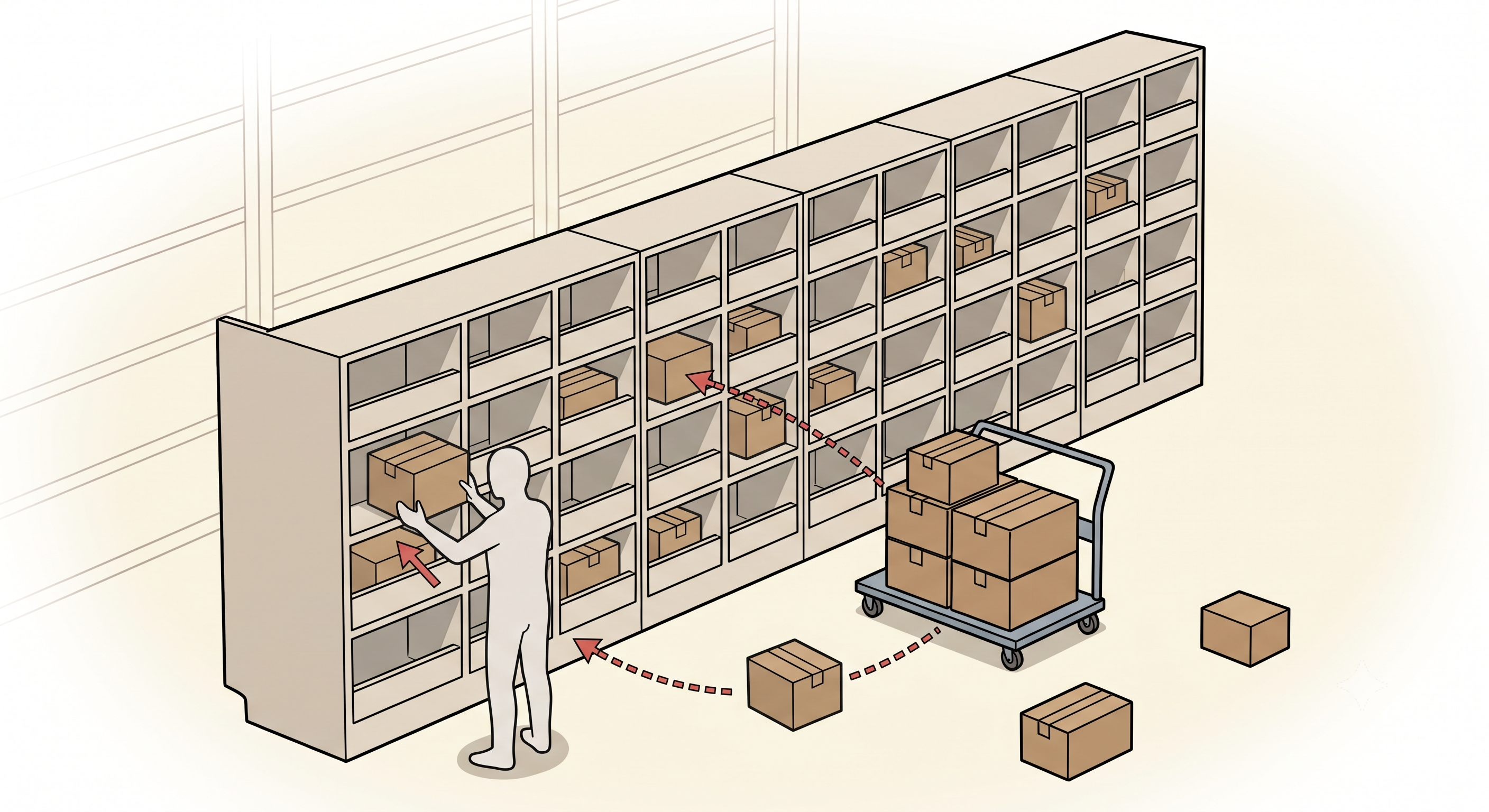
A put wall is a grid of slots, each mapped to an order or destination. Items arrive from batched picks and get placed into the right slot until each order is complete, then packed out the other side.
- Manual put walls use operators guided by put-to-light or display indicators. Capital cost is low and implementation takes weeks, but throughput and the number of destinations is capped by how many items a person can scan and place per hour. Every added shift adds labor cost and hiring risk, and pushes error rates up as fatigue sets in.
- Robotic put walls replace the operator with a stationary robotic arm or vision-guided robot. Labor dependency drops and consistency improves, but each arm serves a fixed wall, gripper limits constrain the product range, and scaling means buying more arms and more walls.
Both share the same architectural ceiling: destination count equals cubby count, and throughput is bounded by induction points. See the full warehouse sortation systems guide for where put walls sit among all ten sorter types.
How tSort works
tSort sorts with a fleet of autonomous mobile robots on an elevated, modular platform. Each robot carries one item from an induction station to its destination and discharges by tray tilt or belt. Because robots work in parallel and destinations are defined in software, a single system sorts over 50,000 items per hour across 6,000+ destinations, handling items from 1 oz to 66 lbs.
Deployment runs 5 to 7 months with no structural modifications, and the platform uses up to 75% less floor space than traditional sorters. No single robot is a point of failure: one going offline doesn't slow the rest of the fleet.
Head-to-head: tSort vs. the put wall category
| Dimension | tSort | Put Walls (Manual / Robotic) |
|---|---|---|
| Product Range | High1 oz–66 lbs; square, round, bagged, loose | Med–Highmanual handles anything; robotic limited by grippers |
| Throughput | Highover 50,000 items/hr | Low–Medbounded by induction rate per operator or arm / robotic induction station |
| Destination Count | High6,000+ per system | Medone destination per cubby |
| Flexibility | Highsort plans reconfigure in software | Medeasy to move, hard to scale |
| Investment & ROI | Highmodular purchase; ROI compounds with volume | Med–Highlow entry cost; ROI erodes as labor scales |
| Space Utilization | Highup to 75% less floor space | Low–Medcompact, but walls multiply with volume and systems with multiple walls require complex routing solutions |
| Batch Size | Highefficient at any batch size | Med–Highstrong for small batches; strained by large waves |
| Implementation Time | High5–7 months | Highweeks — the category's best trait |
| Accuracy | Highconsistent, scan-verified sorting regardless of shift length | Low–Medmanual accuracy depends on operator attention and degrades with fatigue; robotic put walls hold steadier but stay bounded by gripper reliability |
When a put wall might be the better fit
If your daily sort volume is a few thousand items or less, a put wall's economics are hard to beat. The capital barrier is low, implementation takes weeks, and for returns processing, overflow handling, or a small product line, that's the right-sized answer. Robotic put walls extend the case where floor space is tight and SKU variety suits vision-guided handling.
But that math changes once volume climbs past a few thousand items a day. The common response, adding a third or fourth put wall and another shift, is a short-term fix, not a scalable one: each added wall compounds floor space, manual labor, and operational complexity rather than solving the underlying throughput problem.
Put walls also excel at the last step of fulfillment — consolidating a multi-line order into one slot before packing. That's a job tSort doesn't need to replace; it's a job tSort feeds.
When tSort is the better choice
- Labor is the bottleneck. Every put wall shift is recruiting, training, turnover, and error variability. tSort removes the induction ceiling — robots take the repetitive moves, and your people shift to exception handling and pack-out.
- Volume has outgrown the wall. When you're adding a third put wall and a second shift to keep up, you've crossed the line where AMR sortation pays back faster than more cubbies.
- Destinations keep growing. Store-level sortation, zone skipping, or carrier sorts need hundreds to thousands of destinations. Cubby math stops working; software-defined destinations don't.
- Accuracy is contractual. Automated sortation removes mis-sorts from human fatigue — and consistency holds through peak instead of degrading with overtime.
- You want both. The hybrid design, tSort for the primary sort and put walls for final consolidation, is one answer. It also means your existing put wall investment doesn't go to waste. Where consolidation is the step that's straining, tSort3D automates the wall itself.
tSort3D: the best of both worlds
The choice isn't always "keep the put wall" or "replace it with a sorter." tSort3D keeps the put wall format and automates it. A robotic crane places each item into its order location, so the wall still does its job of consolidating orders. Placement just no longer depends on how fast an operator can scan and put.
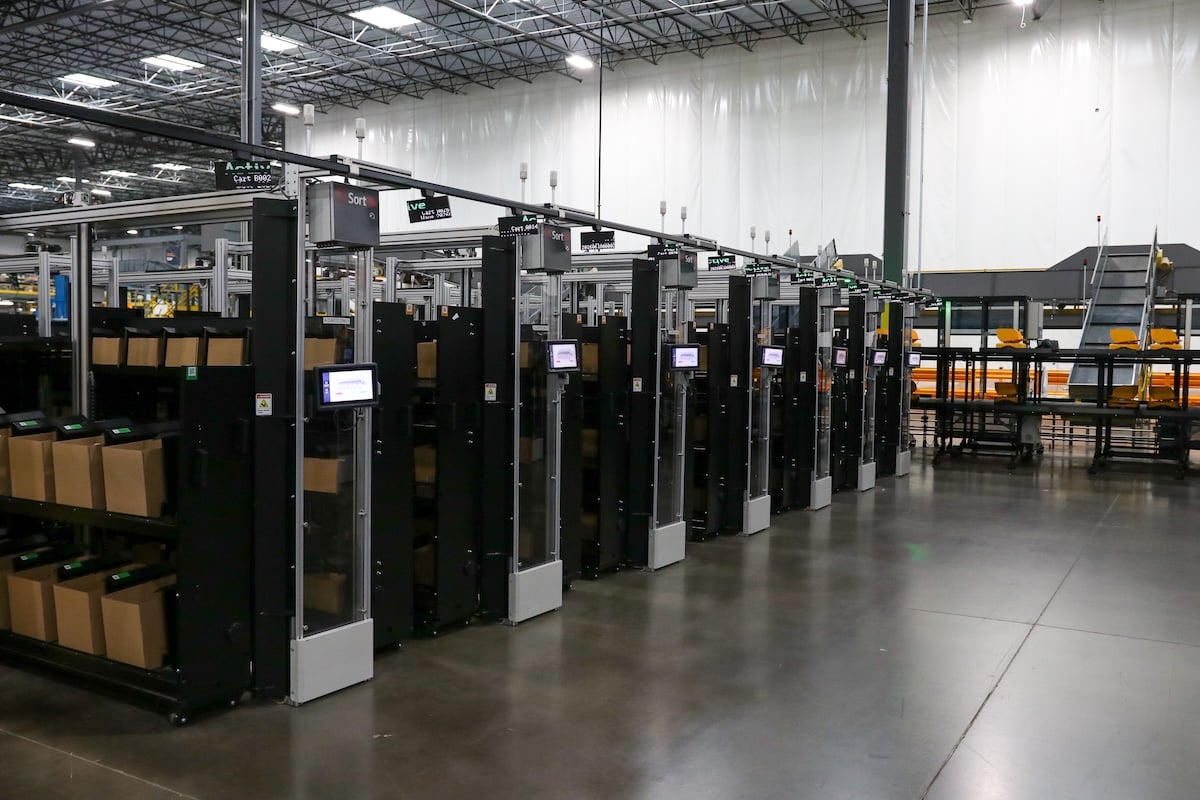
That changes the put wall math in three ways:
- More destinations from the same idea. tSort3D increases sortation destinations by up to 10x and handles 6,000+ orders per wave, which removes the "destination count equals cubby count" ceiling that limits a manual wall.
- Modular throughput. Each module sorts 450 units per hour. You scale by adding modules, not by adding shifts.
- Fewer exceptions at pack-out. tSort3D detects missing containers, overfill conditions, and items that don't reach their destination. Mobile put walls move to packing whole, so completed orders reach pack-out without being handled again.
tSort3D is built for each-picked items up to 11 lbs and 16 x 13 x 13 in, the profile of most e-commerce and retail orders. More than 550 tSort3D units are installed today. It works on its own as an automated put wall, or downstream of tSort as the consolidation step in a fully automated flow. See the tSort3D product page for full specs.
Frequently asked questions
What volume justifies moving from a put wall to automated sortation?
There's no single number, but the crossover usually appears when an operation runs multiple put walls across multiple shifts to keep pace — typically in the 5,000+ items per day range with growth ahead. At that point labor cost, error rates, and peak strain outweigh the low capital cost of adding another wall.
Does tSort replace put walls entirely?
Not necessarily. tSort handles high-throughput primary sortation, and put walls can still handle final order consolidation at pack-out. tSort can feed existing put walls, so the wall stops being the bottleneck and becomes the finishing step instead. When the wall itself is the constraint, tSort3D automates that consolidation step.
How do error rates compare?
Manual put wall accuracy depends on operator attention and degrades with fatigue and turnover. tSort's scan-verified robotic sortation removes the fatigue variable: the error rate at hour 10 of a peak shift matches hour 1.
What about robotic put walls — aren't they automation too?
They are, and they solve the labor problem for moderate volumes. The constraint is architectural: each arm serves one fixed wall, gripper limits narrow the product range, and scaling means duplicating walls. Read the individual matchups for detail: tSort vs. manual put walls and tSort vs. robotic put walls.
What is tSort3D, and how is it different from a put wall?
tSort3D is an automated put wall. A robotic crane handles placement, so it keeps the put wall's role in order consolidation while removing the operator-driven throughput limit. It increases sortation destinations by up to 10x, handles 6,000+ orders per wave, and sorts 450 units per hour per module. It suits operations that have outgrown a manual wall but don't yet need, or want to pair with, full AMR sortation. Explore tSort3D.