 Tompkins Robotics
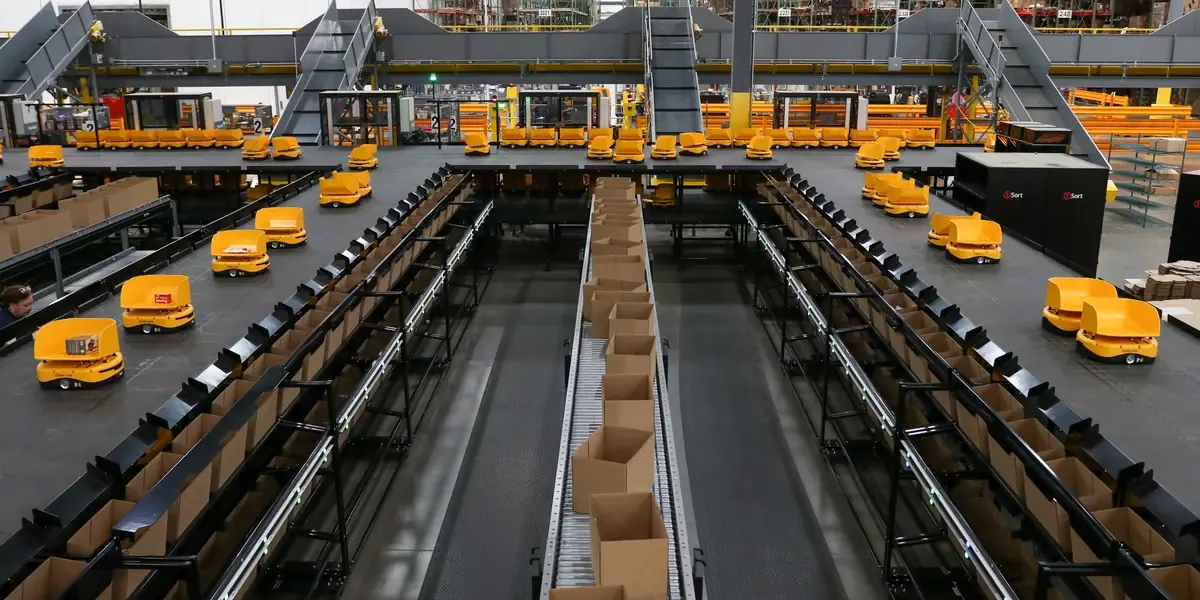
These two get compared constantly, and they shouldn't be: they do different jobs. ASRS automates where your inventory lives. Sortation automates where your orders go. What matters more is which technology solves the bottleneck actually costing your operation money right now. Here's how to tell.
Sortation (tSort)
Routes picked items to the right destination: order, store, route, or carrier. The outbound engine.
ASRS
Stores inventory densely and retrieves it on demand. The storage and picking engine.
Not competitors, but consecutive stages of the same fulfillment flow. "AND," not "VS."
Two different jobs in the same building
An automated storage and retrieval system (ASRS, which includes shuttle systems, cranes, vertical lift modules, and cube storage) solves an inventory problem. It compresses storage into dense racking, brings goods to people instead of people to goods, and cuts the walking that eats most of a picker's shift.
A sortation system solves an order problem. After items are picked, something has to route each one to the right place: the right order, the right store, the right delivery route, the right carrier door. At low volume, people with carts do this. At scale, it becomes one of the most labor-intensive and error-prone processes in the building.
The confusion is natural. Both are big-ticket "warehouse automation," and vendors quote them side by side. But they're consecutive stages of one flow: storage and picking upstream, sortation downstream. For where sortation fits among all its own technology types, see the complete sortation guide.
Side by side: what each one solves
| Sortation | ASRS | |
|---|---|---|
| Core job | Route picked items to the correct destination | Store inventory densely; retrieve on demand |
| Position in flow | Downstream, after picking, before packing/shipping | Upstream: storage, replenishment, picking |
| Bottleneck it removes | Manual sort labor, mis-sorts, missed carrier cutoffs | Picker travel time, storage footprint, slow retrieval |
| Telltale symptom | Picked items piling up at sort points; sort labor scaling with volume | Pickers walking miles per shift; aisles at capacity |
| Typical structure | tSort: modular elevated platform, no structural work, 5 to 7 month install | Dense racking, cranes/shuttles, significant construction |
| Scaling model | Add robots as volume grows | Add modules/aisles — larger, lumpier increments |
Structural comparison of the categories; individual ASRS types vary. Sortation figures reflect the tSort AMR platform.
Which bottleneck first? A quick diagnostic
Put your operation against these signals:
- Sortation first if outbound is where the day breaks down: batched picks waiting at manual sort walls, mis-sorted orders driving chargebacks, seasonal sort labor you can't hire, or carrier cutoffs you keep missing. This is the common profile for parcel, retail store replenishment, and mid-to-high-volume e-commerce.
- ASRS first if inbound and picking are the constraint: storage at capacity, long picker travel, slow order start times — and your outbound sort still comfortably keeps up.
- Both eventually, since most operations that scale end up with each. The sequencing question is payback, and sortation usually wins it: tSort deploys in 5 to 7 months without structural work, while large ASRS builds run longer and cost more. Automating the outbound sort also buys immediate relief on labor and accuracy, the two pressures operators feel first.
Where tSort fits in a combined design
If you already run ASRS or goods-to-person picking, sortation is usually the next constraint — batched picks exit the ASRS faster than manual sortation can consolidate them. tSort is built for that seam: it takes batched output at up to 50,000 items per hour and routes it to 6,000+ destinations, handling items from 1 oz to 65 lbs. Because the platform is modular and software-defined, it drops into an existing building without the structural work you already did once for the ASRS.
Not sure which bottleneck is costing you more?
Walk through your flow with a specialist. You'll get an honest answer, even if the answer is "fix storage first."
Talk to a tSort Specialist Schedule a Virtual Lab TourFrequently asked questions
Is tSort an ASRS?
No. tSort is a sortation system — autonomous mobile robots routing items to destinations. It doesn't store inventory. It pairs with ASRS the way a highway pairs with a parking garage: one holds things, the other moves them where they need to go.
Can a sortation system reduce my storage problem?
Indirectly, sometimes. Faster, more accurate outbound sortation shortens dwell time — inventory spends less time staged on the floor waiting to be sorted. But if racking density or picker travel is the core constraint, that's an ASRS problem.
What does "goods-to-person" mean, and where does sortation fit?
Goods-to-person (G2P) systems — usually built on ASRS — bring inventory to a stationary picker instead of sending the picker walking. G2P speeds up picking; the picked batches still need sorting to orders or destinations afterward. That downstream step is where sortation systems like tSort take over.
We're early in automation. Is sortation too big a first step?
Sortation is often the best first step precisely because tSort scales down as well as up. You start with the fleet your volume justifies, skip any structural modification, and go live in 5 to 7 months. Compare that entry path against staying manual before assuming automation is out of reach.
Keep going
Next in the journey: Automated vs. Manual Sortation · All 10 sortation types compared
Start at the top: tSort — the world's most flexible sorter