 Tompkins Robotics
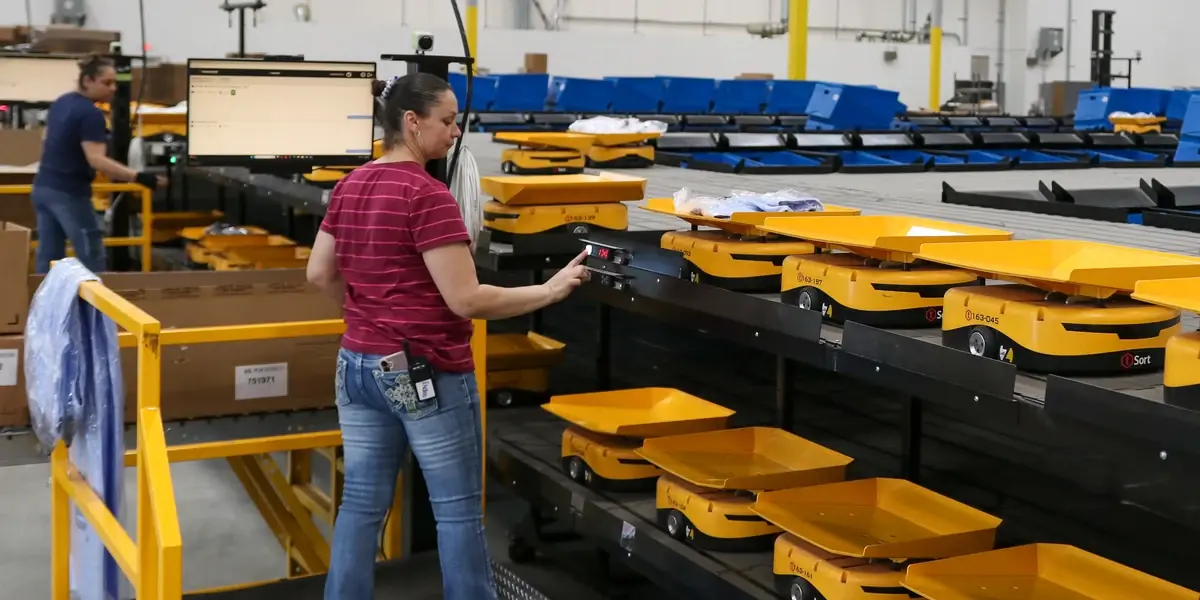
Most distribution operations still sort by hand: people, carts, and cubbies. It works, until three costs start compounding: labor you can't hire, errors you can't afford, and a throughput ceiling that caps your growth. This guide lays out what staying manual actually costs, the signals that it's time to automate, and what the transition looks like.
Automated Sortation (tSort)
Robot fleet sorts 50,000+ items/hr, scan-verified, consistent from hour 1 to hour 10.
Manual Sortation
Operators sort item by item to carts, walls, and staging lanes. Capacity = headcount.
Manual capacity scales with people; automated capacity scales with robots.
What staying manual actually costs
Manual sortation's price tag isn't the wage line. It's everything attached to it.
- Labor that scales linearly. Twice the volume needs roughly twice the people. There's no operating leverage; growth makes the problem bigger, not better.
- A role nobody stays in. Sorting is repetitive, physical, and high-churn. You pay for it in recruiting, training, and the error spike every new cohort brings.
- Errors that compound downstream. A mis-sorted item becomes a chargeback, a re-ship, or a missed store delivery. Human accuracy also degrades exactly when it matters most — hour 9 of a peak shift.
- Peak that can't be staffed. The volume you most need to sort arrives in the season when sort labor is hardest to hire and most expensive to rent.
- A ceiling on the business. When the sort operation maxes out, you're declining volume or missing carrier cutoffs. That cost never shows up on the labor line.
How automated sortation changes the math
An automated system does the routing: scan, identify, and deliver each item to its destination. tSort does it with a fleet of autonomous mobile robots on a modular, elevated platform — 50,000+ items per hour to 6,000+ destinations, items from 1 oz to 65 lbs, scan-verified at every step.
Your people don't disappear from the flow. They move to the ends of it: inducting items, handling exceptions, packing out, while robots take the miles of walking and the repetitive placements in between. Consistency is the quiet win: the sort rate at the end of a shift matches the start, every shift, through peak.
Side by side
| Manual Sortation | Automated (tSort) | |
|---|---|---|
| Capacity model | Headcount × items per person-hour | Fleet size: add robots, not shifts |
| Throughput | A few hundred items per sorter per hour | 50,000+ items/hr per system |
| Accuracy | Degrades with fatigue, turnover, and peak strain | Scan-verified; consistent hour 1 to hour 10 |
| Peak response | Hire temps in the hardest hiring season | Scale the fleet up for peak, back down after |
| Cost curve | Linear with volume, forever | Step investment, then operating leverage |
| Entry point | None, that's its advantage | Modular start; live in 5 to 7 months |
For how automated systems compare against each other, see the 10-sorter comparison guide.
When manual sortation is still the right answer
Below a few thousand items a day, with stable volume and a reliable local labor pool, manual sorting is hard to beat on simplicity. No capital, no integration, no commitment. Operations with genuinely unpredictable, project-based work also benefit from the total adaptability of people.
The mistake isn't running manual — it's not knowing where your crossover point is, and hitting it mid-peak instead of planning for it.
The signals it's time
Automate when the trend lines, not just the totals, point one way:
- Sort labor grows every quarter, and you simply can't find the people to fill it.
- Mis-sort chargebacks and re-ships are a recurring line item.
- You've added a shift (or a second sort wall) and throughput still lags volume.
- Missed carrier cutoffs are costing service levels or expedite fees.
- Growth plans assume sort capacity you don't have a way to staff.
The transition is more gradual than most operators expect: tSort installs in 5 to 7 months with no structural modification, manual processes keep running throughout, and cutover happens in phases — one flow, one client, one wave at a time.
Run your own crossover math.
Bring your volumes, labor costs, and error rates — a specialist will walk the payback calculation with you, honestly.
Talk to a tSort Specialist Schedule a Virtual Lab TourFrequently asked questions
What volume justifies automated sortation?
The economics usually flip when sorting occupies multiple dedicated operators across shifts — commonly 3,000 to 5,000+ items per day (roughly 375 to 625+ items per hour across an 8-hour shift) with growth ahead. But run the math on your numbers: labor cost per sorted item, error cost, and the revenue you can't take because of the ceiling.
What happens to our sort team?
Tasks get automated, not people. Operations that deploy tSort redeploy staff to induction, exception handling, and pack-out — and stop fighting turnover in the highest-churn role in the building, allowing growth with less people.
Do we need a new building or major construction?
No. tSort's elevated modular platform installs without structural modification and uses up to 75% less floor space than traditional sorters — most operations deploy it inside the footprint they already have.
What's the first automation step if capital is limited?
Compare a put wall approach against a right-sized tSort deployment. Put walls have the lowest entry cost; tSort's modular purchasing means the gap is smaller than most operators assume, and only tSort removes the labor ceiling entirely.
Keep going
Next in the journey: All 10 sortation types compared · tSort vs. Put Walls · Sortation vs. ASRS
Start at the top: tSort — the world's most flexible sorter