 Tompkins Robotics

Linear sorters (sliding shoe systems and conveyor-based diverts) move items down a straight line and push them off at assigned spurs. They're the workhorse of carton-based retail distribution: reliable, well understood, and cheaper than loop sorters. The trade: a narrow product range, destination counts capped by the length of the line, and a layout that's fixed the day it's bolted down. tSort removes all three constraints.
tSort: AMR Sortation
Fleet of autonomous robots, multi-level design, no fixed infrastructure, intelligent software, omnichannel fulfillment.
Linear Sorters
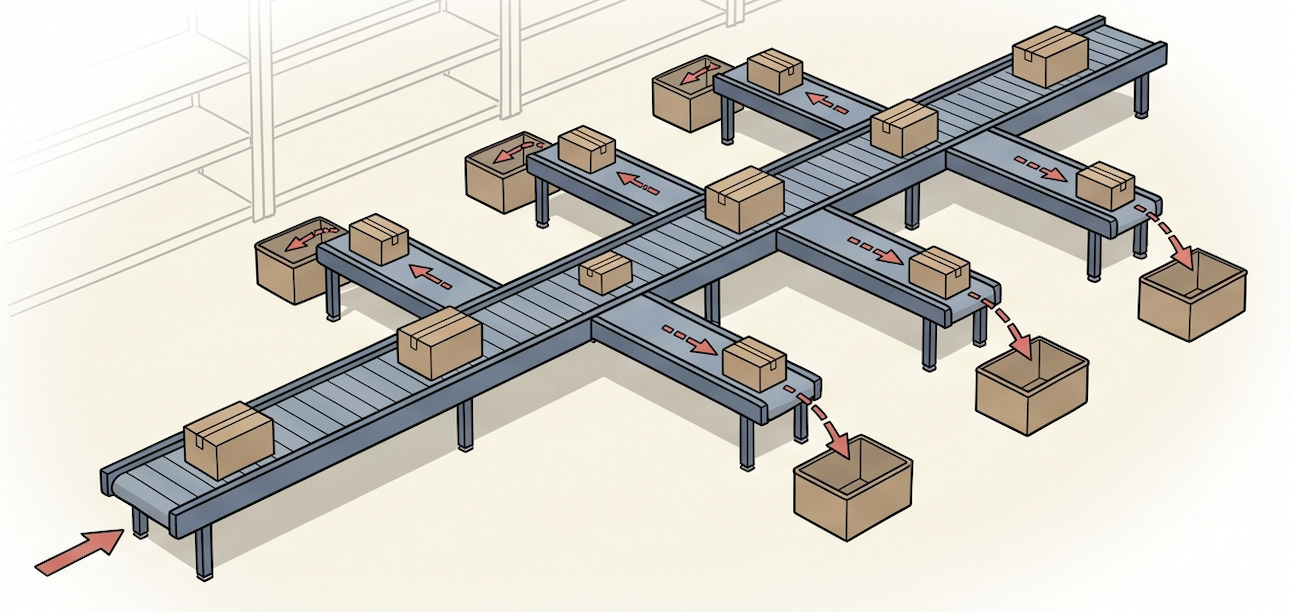
Straight conveyor line with mechanical diverts. Destinations = spurs along the line.
A linear sorter's capacity is the line; tSort's capacity is the fleet.
What counts as a linear sorter?
Linear sorters share one architecture: items travel a straight conveyor path and get diverted onto takeaway spurs. Two families dominate:
- Sliding shoe sorters: slat conveyors with embedded "shoes" that slide diagonally in synchronized groups, pushing cartons onto spurs at 8,000 to 16,000+ cartons per hour. Smooth, fast, and proven in retail DC case sortation.
- Conveyor-based diverts: narrow belt sorters, pop-up wheels, and pusher arms. The most accessible automated sortation by capital cost and install time, best suited to lower volumes and supporting roles.
The shared constraints: items must be flat-bottomed, rigid, and reasonably uniform; destination count is capped by line length; and the line itself is fixed infrastructure, so moving it means rebuilding it. Full detail in the warehouse sortation systems guide.
How tSort works
tSort sorts with a fleet of autonomous mobile robots on an elevated, modular platform. Robots route point-to-point from induction to destination, discharging by tray tilt or belt. A single system sorts up to 50,000 items per hour to 6,000+ destinations and handles items from 1 oz to 65 lbs, including polybags, round items, and loose goods, not just conforming cartons.
The platform installs in 5–7 months with no fixed infrastructure. Built on a wheeled autonomous robot, tSort reduces floor space by up to 75% and enables software-based reconfiguration when sort plans change.
Head-to-head: tSort vs. the linear sorter category
| Dimension | tSort | Linear Sorters |
|---|---|---|
| Product Range | High1 oz–65 lbs; square, round, bagged, loose | Lowflat-bottomed, rigid, uniform items only |
| Throughput | High50,000+ items/hr | Medstrong for cartons; ceiling well below loop/AMR |
| Destination Count | High6,000+ per system | Lowbounded by line length; dozens, not thousands |
| Flexibility | Highreconfigure in software, in hours | Lowbolted-down line; changes are construction |
| Investment & ROI | Highmodular purchase, scale as you grow | Medlow entry cost; cost per added destination climbs |
| Space Utilization | Highup to 75% less floor space | Lowline plus spurs consume long, contiguous floor runs |
| Batch Size | Highefficient at any batch size | Lowtuned for steady case flow, not variable waves |
| Implementation Time | High5–7 months | Medfaster than loops; still fixed-infrastructure work |
| Accuracy | Highscan-verified induction and discharge | Medreliable for compliant cartons; mis-diverts on soft-sided, round, or lightweight items |
When a linear sorter might be the better fit
If your operation sorts uniform cartons or totes to a few dozen destinations at steady volume (classic retail store replenishment), a sliding shoe sorter is a proven, cost-effective answer. The technology is mature, integrators know it cold, and maintenance expertise is easy to find.
Basic conveyor diverts also make sense as supporting infrastructure: zone-level sortation, a secondary sort stage, or a first automation step where volumes don't yet justify a full sortation system.
When tSort is the better choice
- Your item mix stopped being uniform. E-commerce added polybags, apparel, and irregulars to the carton flow. Shoe sorters jam or mis-divert on exactly those items; tSort sorts the full 1 oz–65 lb mix on one system.
- You need more destinations than the line allows. Store-level, zone-skip, or carrier sorts need hundreds to thousands of destinations. A linear sorter gives you what fits along the line; tSort gives you 6,000+.
- Units, not cases. As operations shift from case-level replenishment to unit-level fulfillment, linear sorters sit on the wrong side of the transition. tSort was built for it.
- The legacy line is aging out. Wear parts, noise, and maintenance on mechanical shoe systems climb with age. tSort robots have 14 components each, self-charge, and a robot going down doesn't stop the sort.
- The layout will change. A bolted-down line is a bet the building never changes. tSort relocates, expands, and reconfigures in software.
Sorting more than cartons now?
Bring your real item mix, polybags, irregulars, and all, and watch tSort sort it live.
Talk to a tSort Specialist Schedule a Virtual Lab TourFrequently asked questions
What's the difference between a linear sorter and a loop sorter?
A linear sorter runs items down a straight line and diverts them off the side; a loop sorter circulates carriers around a continuous track. Loops deliver higher throughput and more destinations at much higher cost and install time. Linear systems are simpler and cheaper but narrower in what and where they can sort. tSort outperforms both on flexibility. See the loop sorter comparison.
Can a sliding shoe sorter handle polybags?
Not reliably. Soft-sided and lightweight items shift under the shoe's push and mis-divert or jam. Operations with growing polybag volume typically add manual handling downstream, which is the labor cost tSort removes by sorting bags natively.
How does cost per destination compare?
On a linear sorter, each destination is a physical spur: steel, controls, and floor space. On tSort, a destination is a software assignment on the platform. The more destinations you need, the wider tSort's cost advantage grows.
Is tSort overkill for a simple case-sort operation?
If your operation sorts uniform cases to a stable set of a few dozen doors and nothing is changing, a linear sorter may be the right-sized tool. The evaluation flips the moment item mix, destination count, or the building itself starts moving.