 Tompkins Robotics
If you're looking at a push tray sorter, you probably have a mixed load problem. Cartons, poly bags, shoeboxes, and loose garments all need to reach the right destination, and you don't want a separate line for each. Push tray was built for that job. This guide covers what it does well, where it runs out of room, and how it compares to tSort on the eight dimensions we use to score every sortation type.
What is a push tray sorter?
A push tray sorter is a fixed sortation system that moves items one at a time on three-sided trays along a loop or a straight line. When a tray reaches its assigned destination, a mechanical paddle pushes the item off the open side and into a chute, tote, or outbound carton.
It belongs to the wider tray sorter family, along with split tray (bombay) and tilt tray sorters. All three share the same fixed track and differ only in how the item leaves the tray. Our tray sorter guide covers the full category, and our bombay sorter and tilt tray sorter comparisons put the other two types against tSort.
Push tray lines come in two main configurations. A single line runs one row of trays. A twin line runs two side by side, which roughly doubles capacity on the same track. Many lines accept induction from both sides, and manual induction is common where volume doesn't justify an automated feed.
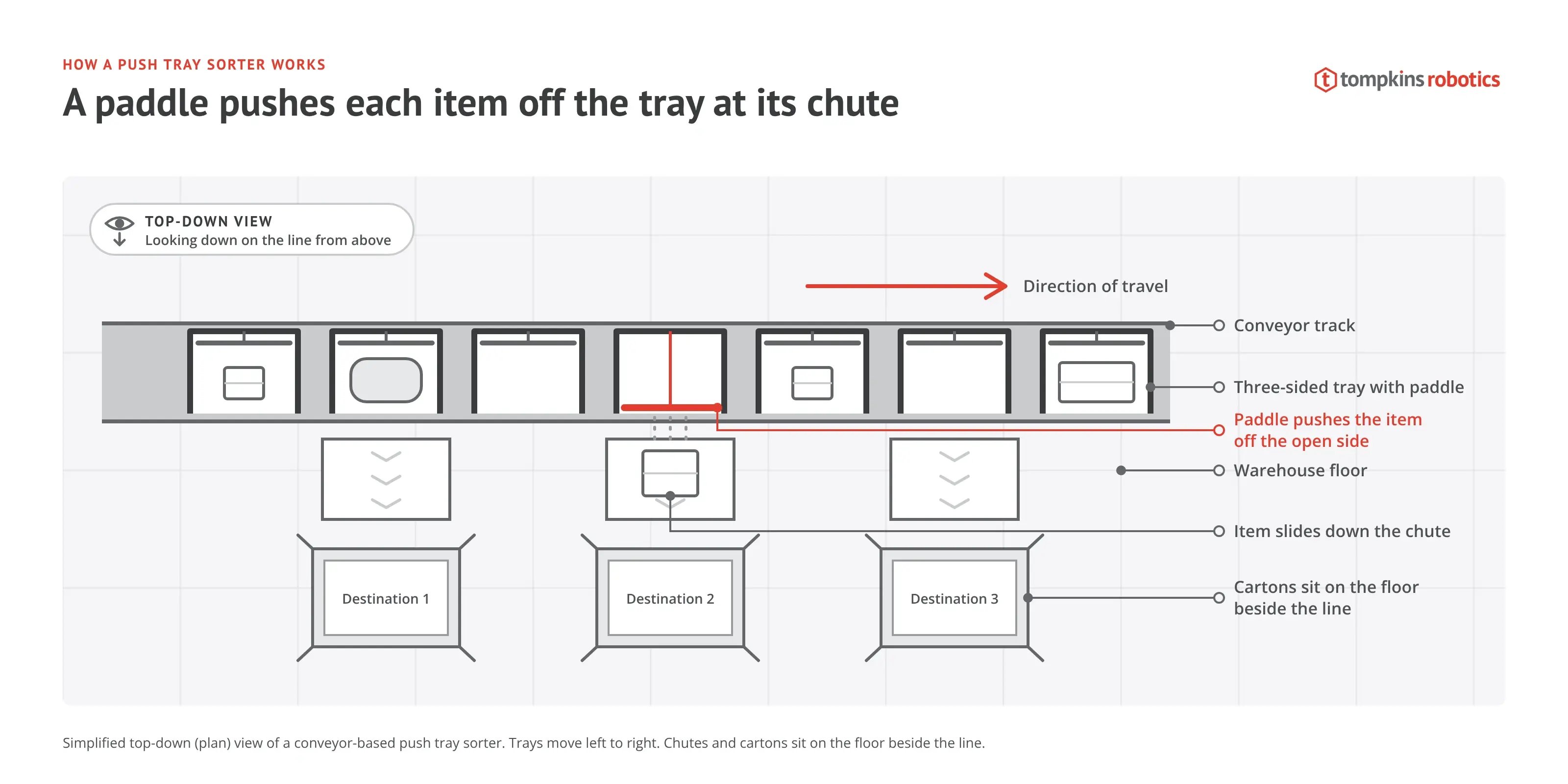
Push tray sorters are built for mixed loads
The paddle is the reason people buy push tray. Because it pushes the item sideways rather than tipping or dropping it, the same tray can carry a rigid carton on one pass and a floppy poly bag on the next. You don't swap hardware between load types. For a retail, apparel, or returns operation with a messy item mix, that matters.
A few other strengths come with the design:
- Direct to pack out: The paddle can push an item straight into an outbound carton or tote, so no one has to touch it a second time.
- Less tumbling: A push discharge is more controlled than a tilt discharge, which helps with mixed and softer items.
- Quiet operation: Most push tray lines run around 70 dB.
- Solid throughput: Industry figures suggest about 2,500 to 15,000 trays per hour for a single line and about 7,500 to 25,000 for a twin line, with carriers rated at roughly 40 to 50 lbs.
Push tray is a common fit in retail, e-commerce, 3PL, and returns, anywhere cartons and poly bags share one line.
Where a push tray sorter hits its limits
The flexibility of a push tray sorter lives in the tray. The system around it is fixed.
The number of destinations depends on the length of the loop or line. Once it's built, adding destinations means extending the track, which takes engineering, fabrication, and downtime. The throughput ceiling is set by the configuration you buy. Moving from a single line to a twin line isn't an upgrade. It's a different machine. And if you ever need to move the sorter, to a new building or a new layout in the same one, that's a construction project too.
The weight range has a ceiling as well. Carriers top out at roughly 40 to 50 lbs, so the heaviest SKUs in a growing catalog may need another path.
None of this makes the push tray a poor choice. It makes it a bet. A push tray sorter works well when your load mix, volume, and destination count all stay close to what you sized the line for. The trouble starts when one of them moves, and in most operations at least one of them does. Seasonal SKU mix shifts. Store and customer counts grow. Peak runs past the line's rating.
How tSort handles the same mixed load
With tSort, a fleet of autonomous mobile robots does the work the trays and track do on a push tray sorter. Each robot carries one item across an elevated modular platform, not the warehouse floor, and discharges it at the right destination. There are no conveyors and no fixed tracks. The Transcend software platform assigns destinations and runs the sort plan.
On the load mix that draws buyers to push tray, the system goes further. It sorts square, round, bagged, or loose items from 1 oz to 66 lbs on one system. Cartons, poly bags, and loose product run side by side, just as they would on a push tray line.
The difference shows up when things change. You add capacity by adding robots, not by rebuilding a line. Sort plans reconfigure in software. And the full system runs in up to 75% less space than a traditional sorter, which leaves room to grow inside the building you already have.
The headline specs: over 50,000 items per hour, 6,000+ destinations, 1 oz to 66 lbs, up to 75% less space, and live in 5 to 7 months. More than 30,000 Tompkins robots run across 300+ installations worldwide.
Note: push tray ranges are rounded industry figures. Exact specs vary by manufacturer and configuration. Push tray is rated in trays per hour and tSort in items per hour, and the two don't convert one to one. Our bombay sorter comparison explains how to compare them fairly.
Push tray holds its own on the mixed-load question. The gap opens on everything the tray doesn't control: destinations, growth, space, and what it costs to change your mind.
Kmart Australia runs the load mix push tray is built for
Kmart Australia handles tens of thousands of SKUs across cartons, poly bags, loose items, and mixed packaging. That's the mix push tray sorters are sold on. Kmart sorts it with tSort.
The results: installation to go-live in under 5 months, roughly 50% lower capital investment than a traditional tilt tray or crossbelt system, and a footprint cut by more than 60% while processing capacity went up.
"Tompkins' customer-first approach is refreshing and leads to constantly challenging the status quo," said Dean Goulding, Head of Assets, DC Design and Automation at Kmart.
For a straight fixed-sorter swap, look at the major global retailer that replaced a traditional fixed sorter with tSort. It reached 99.9% sortation accuracy, increased its sortation destinations by 250%, and finished installation in 7 weeks.
Making the decision, push tray vs tSort
Push tray is a good machine for a specific situation. Consider it when:
- Your load mix is wide but stable, and you don't expect heavier SKUs.
- Your destination count won't grow much over the life of the line.
- Your volume is predictable and sits comfortably inside one configuration.
- You have the floor space for a dedicated line and no plans to move it.
If any of those is likely to change in the next five years, price the change before you commit. Ask what it costs to add 200 destinations in year three, how long the line would be down, and what happens when a 60 lb SKU shows up. Then compare that with adding robots.
To see how tSort would handle your load mix, talk to a tSort specialist or schedule a lab tour.


Talk to our team
Let's talk about your sortation operation.
Our team can help you identify where robotic automation can make the biggest impact in your operation, from robotic sortation and product movement to autonomous pallet handling.