 Tompkins Robotics

tSort and linear tilt trays, side by side
| Dimension | tSort | Tilt Tray |
|---|---|---|
| Product Range | High: 1 oz to 65 lbs | Medium: limited by gravity discharge |
| Throughput | 50,000+ items/hr | 10,000 to 60,000 items/hr |
| Destination Count | 6,000+ | Limited by conveyor length |
| Flexibility | Fully reconfigurable and easily expandable | Fixed conveyor track, changes require construction |
| Investment and ROI | Modular, buy as you grow | $500K to $5M+ needed upfront to purchase the entire track with initial installation |
| Space Utilization | Up to 75% less floor space, less than 5 sq ft per destination | Large dedicated footprint |
| Implementation Time | 5 to 7 months | 12 to 24+ months |
| Accuracy | Scan-verified at induction and discharge, zero no reads | High for compatible items; gravity discharge can mis-sort fragile, round, or very light items |
tSort column highlighted in Tompkins Robotics red.
What is a tilt tray sorter?
Tilt trays are traditionally a conveyor-based, linear sorter system built on heavy, fixed infrastructure. The trays are mounted to a fixed conveyor that runs on a permanent track, with chutes lined up along its length. Each tray travels down that track, and when it reaches its assigned destination a cam mechanism tilts it to one side so gravity slides the item into a chute below. Scanners identify each item at induction and the system triggers the tilt at the correct divert point. The same tilt-tray mechanism can also be arranged in a loop configuration, but the principle is the same: trays locked to a fixed line of conveyor.
These systems handle poly bags, small parcels, and corrugated boxes at speeds up to 600 packages per minute. But because they rely on gravity to discharge items, they struggle with fragile, round, or very light products, and require wide destinations to ensure sorted items accurately leave the tray.
In practice, they show up most often in high-volume parcel distribution centers, e-commerce fulfillment operations with predictable year-round demand, and apparel logistics where the product mix is relatively uniform. They work well when throughput is steady, the product range is narrow, and the facility layout won't change much over the system's 10 to 15 year lifespan.
Measured against those four criteria, a linear tilt tray sorter looks like this:
Throughput volume
10,000 to 60,000 items/hr
Destination count
Limited by conveyor length
System flexibility
Fixed conveyor track, changes require construction
Installation timeline
12 to 24+ months
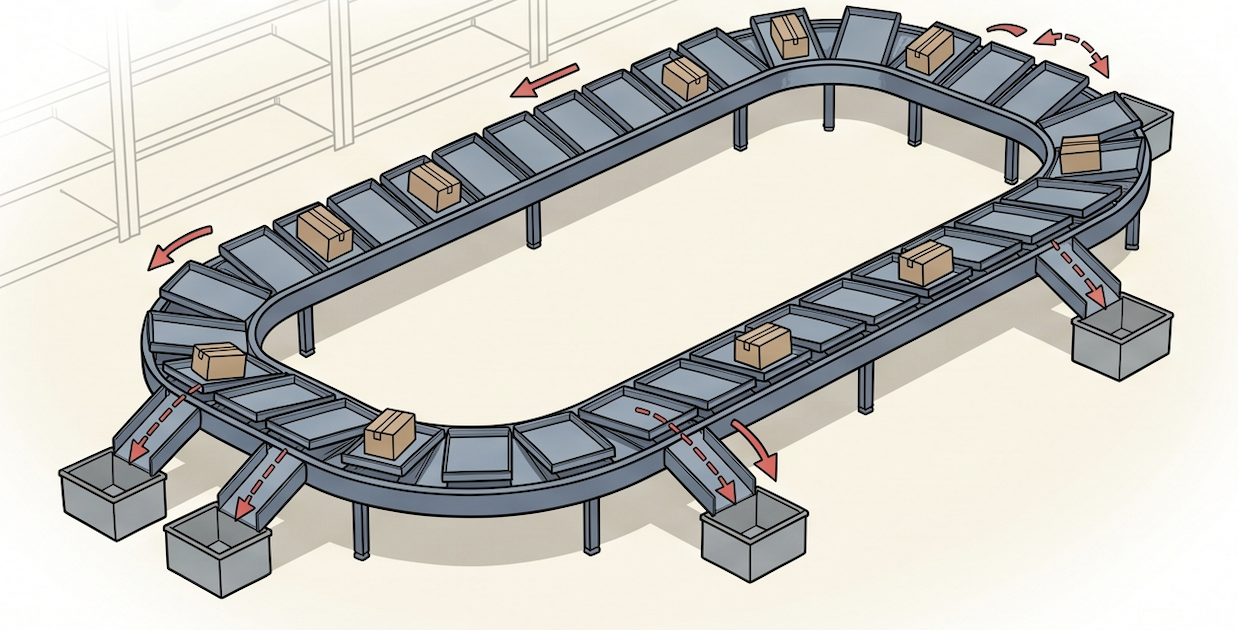
The tilt tray is the discharge mechanism, not the architecture. tSort uses a tilt tray too. The difference is what carries it.
Related Guide
Warehouse Sortation Systems: The Complete Comparison
See how tSort and conveyor tilt trays stack up against cross-belt, sliding shoe, pouch sorters, and more. Read the full guide →
How tSort is different
With a conveyor-based tilt tray sorter, the trays are locked to a fixed path. tSort puts each tilt tray on its own autonomous mobile robot (AMR) instead. The robots travel independently across a raised sorting platform, route themselves to the correct destination along the shortest path, and discharge the item with the same controlled tilt. A tSort robot comes to a complete stop before discharging the item, thus allowing destinations to be tightly located side by side.
So both systems tilt a tray to drop the item. What changes is everything around it: no track, no permanent conveyor infrastructure. You add or remove robots to match your volume, reconfigure destinations in hours, and deploy the full system in five to seven months. That flexibility is the whole point: scale the fleet up or down and re-slot destinations on the fly, without the rework a fixed system demands.
Across the same four criteria, tSort tells a different story:
Throughput volume
50,000+ items/hr
Destination count
6,000+
System flexibility
Fully reconfigurable
Installation timeline
5 to 7 months
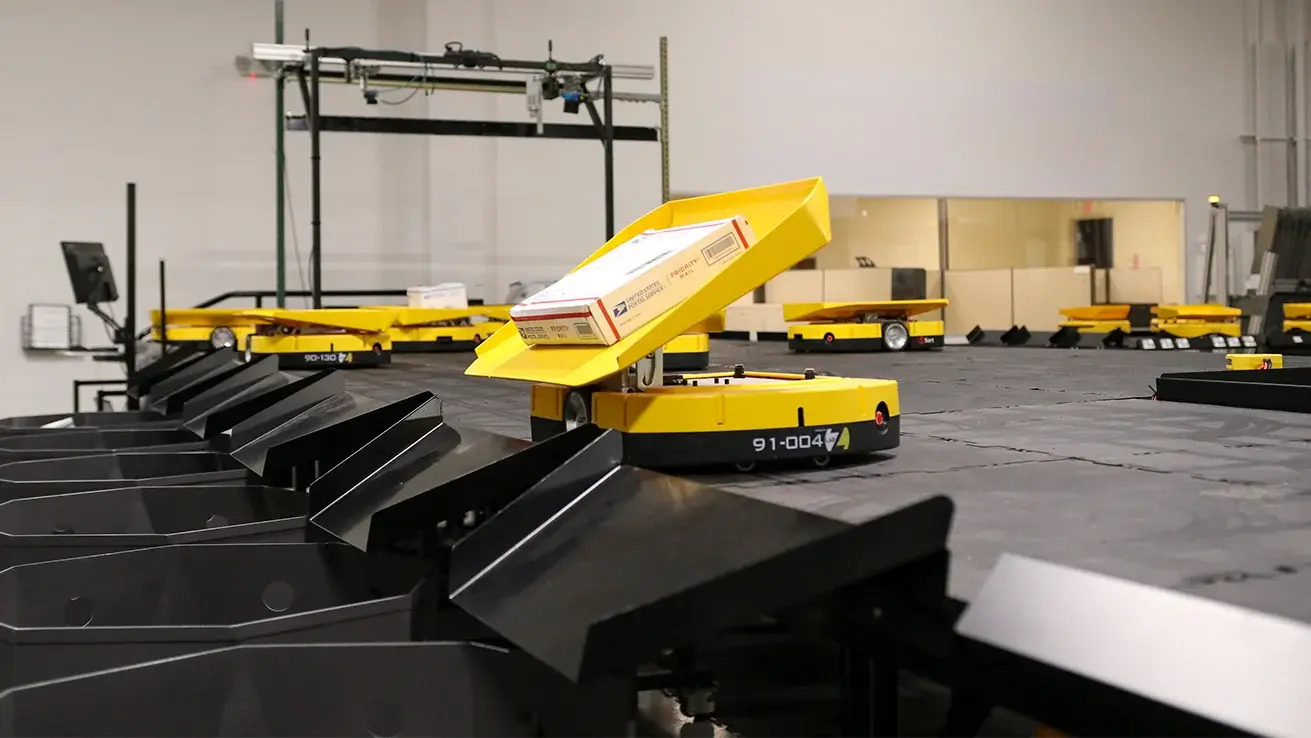
When tSort is the better choice
tSort wins when your operation needs to change, and flexibility is where it pulls furthest ahead. If your warehouse layout changes, your SKU mix shifts seasonally, or you sort to hundreds or thousands of destinations, a fixed-run system forces you into expensive, time-consuming reconfigurations. tSort, the most flexible system in this comparison, reconfigures in software instead.
The modular purchasing model also changes the capital equation. Instead of committing millions upfront for a system sized to your peak demand, you start with what you need and add robots as volume grows. Your sortation cost scales with your actual throughput rather than running at full cost regardless of volume.
And because each robot operates independently, there's no single point of failure. One robot offline doesn't stop your operation. A conveyor tilt tray loop going down stops everything.
Get in Touch
Ready to Learn More About tSort?