 Tompkins Robotics
A typical warehouse only moves four things: items, parcels, cases, and pallets. Virtually every warehouse automation solution is designed to move one or a combination of these four. Once you look at automation through that lens, the market becomes much easier to understand.
Once you see the market this way, the question isn't, “Which technology is best?” There is no universal answer. The right technology depends on what you're moving, what you've already automated, and where you need to go next. The more important question is where you start — and what that first decision commits you to down the road.
The wrong sequence can create costly constraints that are difficult to undo. The technology itself is rarely the problem; it's deciding what to automate first, or next, and what that choice means for the rest of the operation. Start with what actually moves through the warehouse, and the path becomes much clearer.
Four categories, sorted by what moves
Items
Individual units, picked to fill an order.
Moved by
- AS/RS
- Goods-to-person
- Pick and place robots
- Guided manual picking
- Conveyor systems
- Sortation systems
Parcels
Individual shipping units, typically ready to be shipped to a customer (e.g., polybags, padded envelopes, small boxes), often for e-commerce.
Moved by
- AS/RS
- Goods-to-person
- Pick and place robots
- Guided manual picking
- Conveyor systems
- Sortation systems
Cases
Larger units containing multiple identical or related items, usually packaged together for store replenishment.
Moved by
- AS/RS
- Goods-to-person
- Pick and place robots
- Guided manual picking
- Conveyor systems
- Sortation systems
Pallets
Bulk loads, moved between zones and out the door.
Moved by
- Pallet AS/RS
- Autonomous pallet movers
- AGVs
- Automated forklifts
- Conveyor systems
- Robotic palletizing/depalletizing
Everything else in the building coordinates those four or reports on them. Software such as ERP, WMS, or WCS determines how work is planned, prioritized, and executed throughout the warehouse. Scanners and sensors tell it what happened and when. Each matters, but they aren't part of the four material-flow automation categories we're examining. Software can multiply the capabilities of the automation you've built, but it can't substitute for the physical automation you haven't.
Picking automation: getting items to the person
Picking is where most operations start, and it's the most crowded category by far.
Picking AS/RS and goods-to-person systems bring inventory to a stationary picker instead of walking the picker to the inventory. Note that while all AS/RS are goods-to-person systems, the reverse is not true; some goods-to-person solutions transport inventory but do not actually store it, meaning they do not qualify as AS/RS.
Picking automation covers several distinct configurations:
- Mini-Load AS/RS: Rail-guided cranes in narrow aisles retrieve bins or totes and transfer them to picking stations.
- Shuttle AS/RS: High-speed shuttles move horizontally across individual racking tiers to fetch cases or trays.
- Vertical Lift Modules (VLMs): Enclosed, vertical tower systems that utilize a central lift to deliver inventory trays to a retrieval window.
- Cube-Based AS/RS: Bins are stacked tightly in a vertical grid, with robots traveling across the top to dig out and deliver specific bins (e.g., AutoStore).
- Mobile AS/RS: Autonomous robots move in multiple directions (both horizontally and vertically) through the racks to retrieve bins directly (e.g., Exotec).
- AMR-Based Goods-to-Person: Autonomous mobile robots transport inventory, totes, carts, or mobile shelving to stationary operators.
- Conveyor-Based Goods-to-Person: Conveyors transport totes, bins, cases, or cartons from storage areas directly to picking or processing stations.
Picking is one of the most labor-intensive and time-consuming warehouse processes. These systems bring inventory directly to the operator, reducing travel, walking, bending, and reaching while allowing workers to spend more time actively picking.
One distinction worth getting right, because most articles blur it: AS/RS is storage and retrieval. It feeds picking. It isn't picking. The pick still happens at a station, by a person or an arm.
Robotic piece picking is that arm. Vision systems identify the item, the gripper takes it, and the whole thing works well within a defined SKU range. Outside that range it still struggles, which is why most deployments run it alongside people rather than instead of them.
Guided manual picking covers pick-to-light, voice picking, and cart picking. It is worth noting that these systems are also frequently integrated directly within AS/RS and goods-to-person systems. It's the oldest layer and remains one of the most widely deployed approaches to warehouse picking today. For low-volume, high-variability operations it's often the correct answer, and companies like GreyOrange have spent years on the orchestration software that decides how those picks get batched and released in the first place.
Sortation automation: routing picked goods to the right destination
Once goods are picked, they need to get to the right destination. Sortation separates a mixed flow of goods and routes them to bins, cartons, gaylords, or other destination containers. It can consolidate items by order, customer, store, carrier, or shipping lane, helping operations move goods through the warehouse faster while reducing manual handling and the risk of errors.
Sorting machines fall into three general families.
Fixed Sorters
Put Walls
AMR-Based Sortation
Fixed sorting machines are the tilt-tray, crossbelt, shoe, and linear sorters that have run distribution centers for decades. They are fast, proven, and hard to argue with on peak throughput. They are also concrete, steel, and a destination count you fixed in a design meeting years ago. Changing that count means changing the building.
Put walls sit at the other end. Cheap to install, simple to run, and capped by the number of cubbies you can physically reach. They work well until volume or destination count grows past the wall.
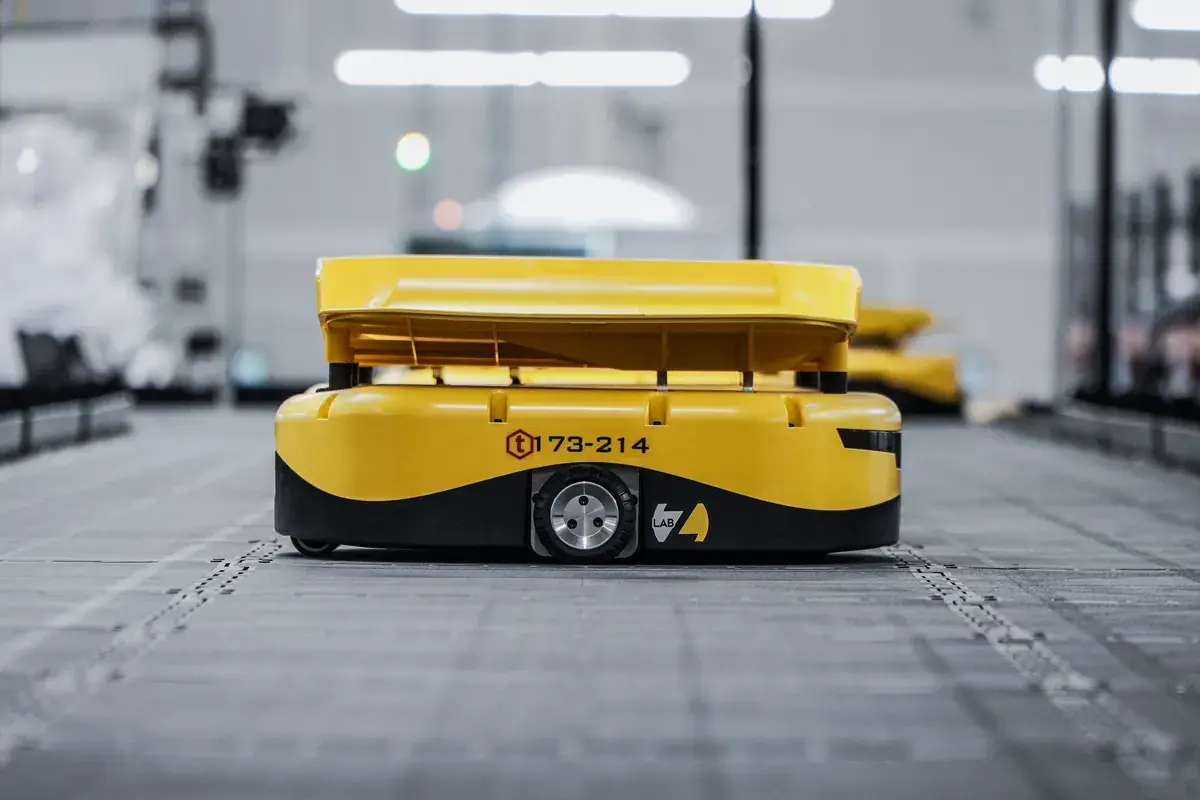
AMR-based sortation uses fleets of small robots running on a modular platform. Robots transport goods between induction stations and destination containers. The trade is straightforward: you give up some peak ceiling against the largest fixed sorters, and you get a system you can reconfigure, expand, or relocate. Add destinations by adding platform. Add throughput by adding robots. tSort is one example of this approach, and tSortPost adapts the same idea for parcel and postal operations, where destination counts change constantly and buildings rarely have room to spare.
Automated package sorting is also where the labor math changes most sharply, because manual sortation scales linearly. Twice the volume takes twice the people. None of the three families above work that way.
Which family fits depends less on your volume than on how often your destinations change. That comparison is worth its own read: see our breakdown of warehouse sortation types for the head-to-head.
Pallet movement automation: the layer most plans skip
Pallets get moved by forklifts, and forklifts get driven by people, and that arrangement has been stable long enough that most automation plans don't touch it.
Three options have gotten meaningfully better. AGVs follow fixed paths and have been around for years. Autonomous forklifts handle full pallet putaway and retrieval. Autonomous pallet movers like PickPallet run point-to-point transport between zones.
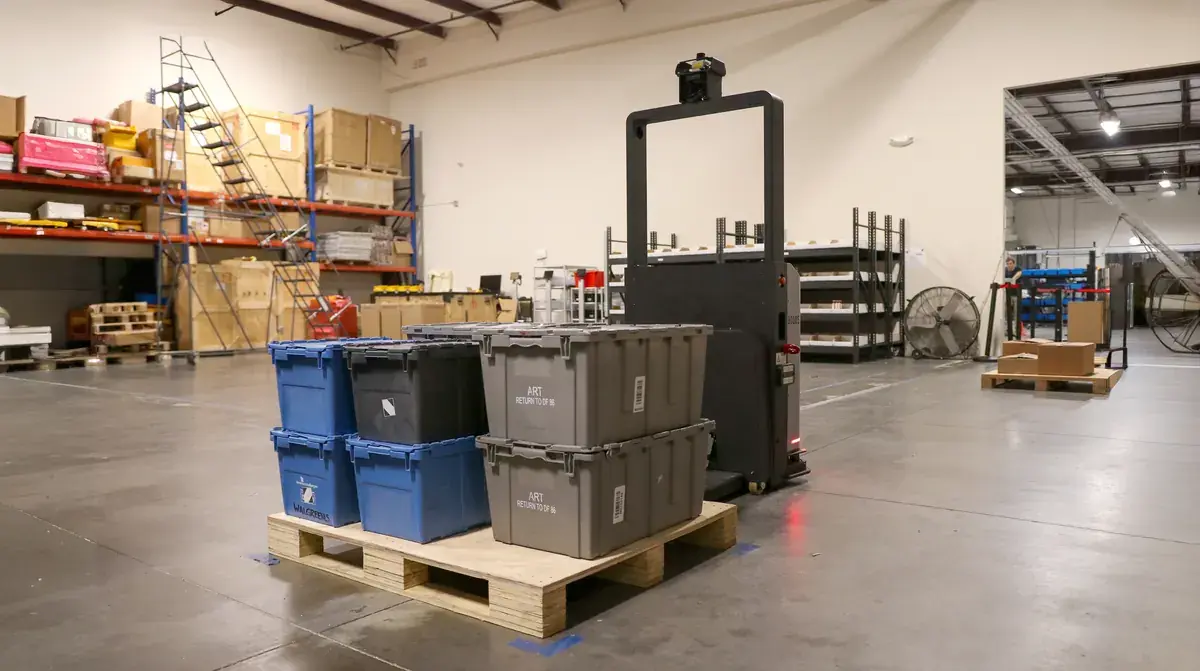
What changed is navigation. These systems used to require magnets in the floor or wire guidance buried in concrete, which made every deployment a construction project. Now they map the building and navigate it, which turns a capital project into something you can add to a facility that's already running.
Be clear-eyed about the business case, though. Pallet automation usually pays on labor hours and safety incidents rather than throughput. That's a real return, and it's a different return than the other two categories deliver. If you're building a case on units per hour, this isn't the category that makes it.
Don’t fall victim to automating out of order
Now the part that matters more than any individual technology.
Picking gets automated first, almost every time. It's the most visible labor cost, it's the most heavily marketed category, and the pitch is easy to follow. So the system goes in, and often the numbers don't land the way the model said they would.
The reason is usually downstream, and it comes down to batch factor.
Batch factor is the throughput multiplier you get from picking for many orders at once and sorting the results afterward. Pick one order at a time, walk it, complete it, start the next: your batch factor is 1. Pick for 50 orders in a single pass and let an automated system sort the results into 50 destinations, and your multiplier climbs into the 10 to 50 range and beyond.
Discrete picking. One order, walked and completed before the next.
Batch picking. Ten orders picked in a single pass, sorted afterward.
Cart batch picking + automated sortation. Fifty or more orders per pass, sorted by machine downstream.
Batch factor: the throughput multiplier from picking many orders at once and sorting the results afterward, rather than completing one order before starting the next.
That multiplier only exists if something downstream can absorb the flow. A picking system's rated rate is theoretical until sortation can keep up. At CVS's Lumberton, NJ distribution center, tSort runs downstream of an AutoStore system, and daily throughput there climbed from 150,000 to over 400,000 units — a jump picking alone doesn't produce. It takes a sortation layer that can move at the same rate the picks arrive, in this case built into a 10,700-square-foot footprint inside a distribution center topping 1,000,000 square feet.
The constraint is rarely where the labor is loudest. It's wherever work piles up waiting for a decision. Those are different places more often than not, and the second one is much easier to miss because nobody is visibly busy there.
Where to start
Sort the technology by what it moves, then find the place where work waits. Items, parcels, cases, pallets: four categories, four sets of options, and one sequencing question that determines whether any of it returns what the model promised.
If you want the full argument on picking and sortation working together, including the batch factor math and a comparison across sortation technologies, our whitepaper on maximizing picking and sorting automation goes deeper than an article can.
FAQ
What is warehouse technology?
Warehouse technology covers the systems that move, store, track, and route inventory inside a facility. It spans automation hardware like picking and sortation systems, and the software layer, mainly warehouse management and execution systems, that decides what the hardware does.
How does automated package sorting work?
An automated sorting system reads a label or barcode on each package, looks up its destination, and physically diverts it there. Depending on the system, the divert happens through a tilting tray, a moving belt, a pusher arm, or a robot carrying the item to a chute.
What are the main types of sorting machines?
Fixed sorters (tilt-tray, crossbelt, shoe, and linear), put walls, and AMR-based robotic sortation. Fixed sorters offer the highest peak throughput with the least flexibility. Put walls are the simplest and cap out earliest. AMR systems sit between them and can be reconfigured as destination counts change.