 Tompkins Robotics
What is a split tray (bombay) sorter?
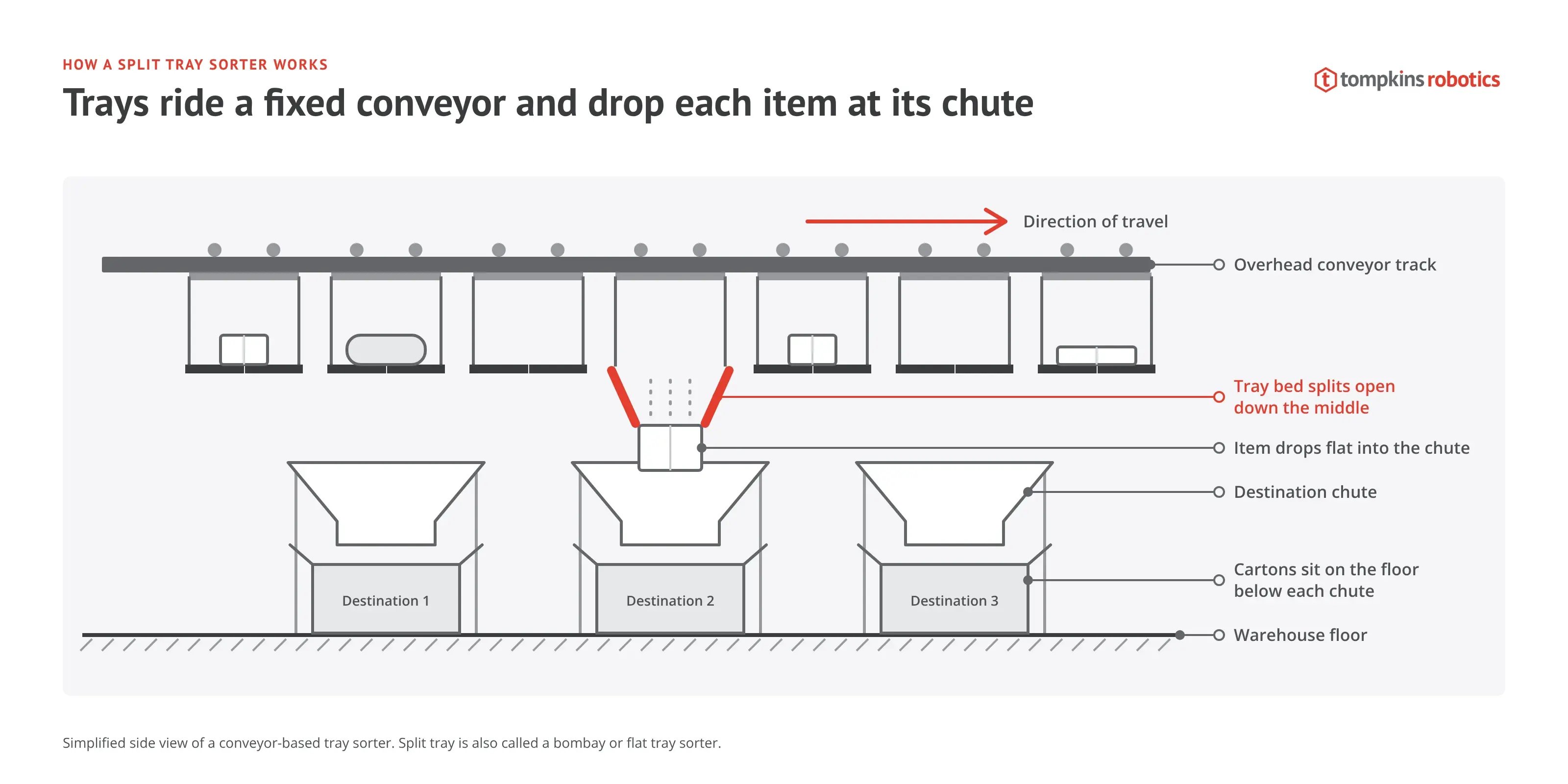
A split tray sorter is a fixed warehouse sortation system that moves items one at a time on flat trays along a loop or a straight line. When a tray reaches its assigned destination, the tray bed splits open down the middle and the item drops straight through into a chute, tote, or carton below.
The same machine goes by three names: split tray sorter, bombay sorter, and flat tray sorter. It belongs to the tray sorter family, along with push tray and tilt tray sorters. All three ride a fixed track and differ only in how the item leaves the tray. Our tray sorter guide covers the full category.
Built for small, light items at high volume
The flat drop is the point. The item doesn't slide, tip, or get pushed. It falls straight down, so it lands where it should with little tumbling. That makes split tray a good fit for apparel, pharmacy and health products, books, media, mail, and other small items that sort cleanly into a carton or bag.
A few other strengths come with the design:
- Loose items: Unbagged and loose items are common on split tray lines.
- High rates: Multi-lane configurations reach very high tray rates on one track.
- Simple induction: Manual induction keeps the entry cost down where volume doesn't need an automated feed.
Industry figures suggest about 2,500 to 17,500 trays per hour for a single line (roughly 5,000 to 35,000 items per hour), about 7,500 to 35,000 for a dual line, and about 15,000 to 70,000 for a quad line. Tray capacity runs roughly 15 to 25 lbs.
Split tray shows up most in postal, pharmaceutical, retail, and apparel operations.
Where a bombay sorter hits its limits
The same design that makes split tray good at small items sets its limits.
Weight comes first. With tray capacity around 15 to 25 lbs, anything heavier needs a different path. For an operation whose SKU mix is drifting toward bulkier product, that ceiling arrives sooner than expected.
Destinations come next. The number of drop points depends on the length of the loop or line. Adding destinations means extending the track, which takes engineering, fabrication, and downtime.
Throughput and layout are fixed too. The rate ceiling is set by the configuration you buy. Going from a single to a dual line means a different machine, not a settings change. Moving the sorter to a new building or a new layout is a construction project.
This isn't to say split trays are a poor choice. A bombay sorter can work well when your item profile stays small and light and your destination count stays put. The risk is that your network grows, your catalog gets heavier, or peak outruns the line, and the sorter can't follow.
Trays per hour vs. items per hour
Split tray vendors quote throughput in trays per hour. The rate for tSort is quoted in items per hour. These aren't the same number.
Trays per hour measures how many trays the line moves. Items per hour measures what actually gets sorted to a destination, and that depends on how the line is loaded and configured. Be mindful of the difference here when trying to compare. Industry figures for a single split tray line, for example, run about 2,500 to 17,500 trays per hour and roughly 5,000 to 35,000 items per hour.
So compare carefully. A quad split tray line posts very high tray rates. The better question is what your operation needs to sort per hour at peak, across your whole SKU mix, and what it takes to raise that number in year three. On a split tray sorter, raising the ceiling means a new configuration. On tSort, it means more robots.
How tSort handles the full SKU range
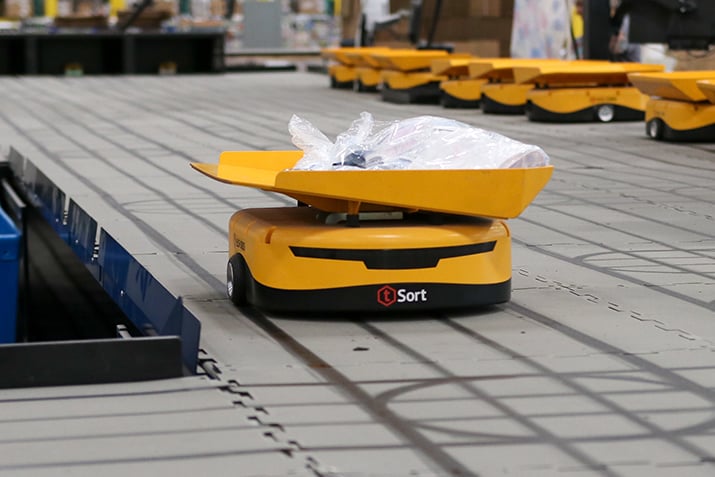
With tSort, a fleet of autonomous mobile robots does the work the trays and track do on a split tray sorter. Each robot carries one item across an elevated modular platform, not the warehouse floor, and discharges it at the right destination. There are no conveyors and no fixed tracks. The Transcend software platform assigns destinations and runs the sort plan.
The weight range is where the gap is widest. The system sorts square, round, bagged, or loose items from 1 oz to 66 lbs on one system. The small, light items a bombay sorter handles well run on the same system as the heavier cartons it can't take.
Growth works differently too. You add capacity by adding robots. Sort plans reconfigure in software. The system supports 6,000+ destinations, runs in up to 75% less space than a traditional sorter, and sorts with 99.9% accuracy.
The headline specs: over 50,000 items per hour, 6,000+ destinations, 1 oz to 66 lbs, up to 75% less space, and live in 5 to 7 months. More than 30,000 Tompkins robots run across 300+ installations worldwide.
Split tray sorter vs. tSort comparison
Note: split tray ranges are rounded industry figures. Exact specs vary by manufacturer and configuration.
A fixed sorter replaced, and 250% more destinations
A major global retailer replaced a traditional fixed sorter with tSort at a warehouse that services over 450 stores daily. Sortation accuracy rose to 99.9%. Sortation destinations went up by 250% in the same building. The project ran 7 months from order to fully operational, with an installation of only 7 weeks. Operators were filling orders after 15 minutes of instruction.
Destination density is the other half of the story. At its Lumberton distribution center, CVS runs 616 sortation destinations in a 10,700 sq ft footprint inside a building of over 1,000,000 sq ft. It reaches over 99.9% pick accuracy and 40% lower operational costs than other CVS distribution centers, with tSort deployed alongside AutoStore. That's pharmacy retail distribution, one of the segments where split tray sorters show up most.
Making the decision
A bombay sorter could fit some operations, and only you can weigh that against your own volume, SKU mix, and growth plans. It tends to fit best when:
- Your items are small and light, and they'll stay that way.
- Your destination count won't grow much over the life of the line.
- Your volume is steady and fits one configuration.
- You have the floor space for a dedicated line and no plans to move it.
If your catalog is getting heavier, your network is adding stores or customers, or peak keeps outrunning your rating, price those changes before you commit to a line. Ask what it costs to add destinations in year three, what happens to items over 25 lbs, and how long a reconfiguration takes. Then compare that with adding robots.
To see how tSort would handle your SKU range, talk to a tSort specialist or schedule a lab tour.


Talk to our team
Let's talk about your sortation operation.
Our team can help you identify where robotic automation can make the biggest impact in your operation, from robotic sortation and product movement to autonomous pallet handling.